Reseller guide
How Much Do IPTV Resellers Make? Cost per Customer Worksheet
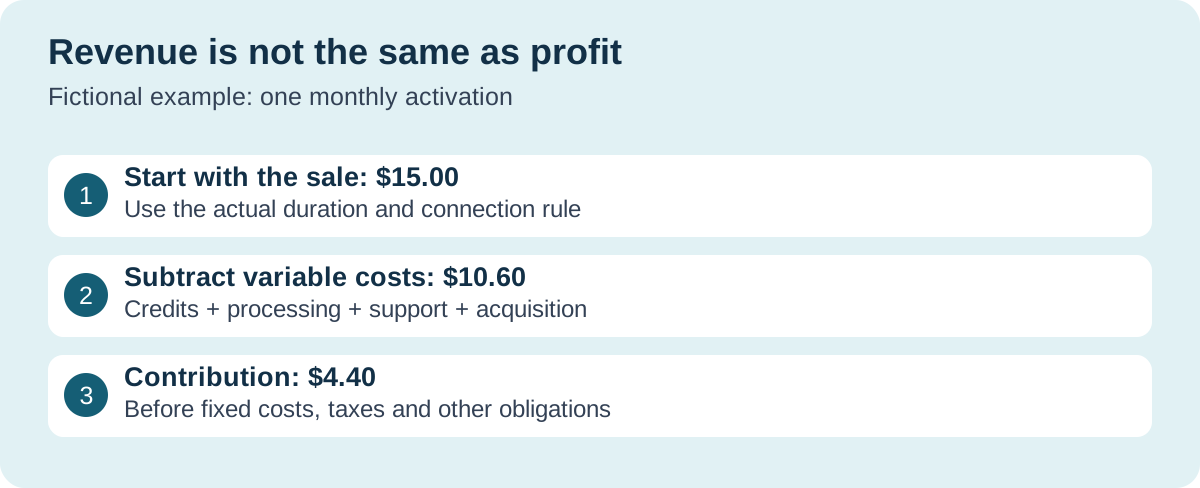
There is no reliable universal earnings figure for an IPTV reseller. A sales price is not profit, a panel balance is not money in the bank, and a large credit discount does not tell you how much support a customer will need. Calculate the cost of the exact plan you intend to sell before comparing wholesale offers. This worksheet uses fictional numbers, not supplier quotations, surveyed earnings or a promise of income.
Commercial disclosure: this site promotes reseller offers and links to commercial services. Check current written terms before buying. A favourable result in an illustrative worksheet does not establish that a supplier, customer base or content-distribution arrangement is viable.
Define one sale before calculating a margin
Choose a unit you can describe precisely: for example, one activation for one month with the written connection limit attached. A twelve-month sale and a one-month sale carry different obligations, so do not mix them in one average without accounting for their duration. Record whether an extension uses the same credits as a new line, whether trials consume credits, and whether another simultaneous connection costs extra.
The credit schedule matters more than the name of the package. A supplier may change its rules or quote different schedules for different plans. Keep the dated quotation, currency, expiry conditions and any panel fee beside your calculation. Our panel trial checklist explains how to compare a permitted test transaction with the panel's recorded debit.
Convert the credit purchase into a cost per activation
Use the amount you actually pay for the block, including any non-refundable purchase charges you are including in that cost basis. Divide by the usable credits received, then multiply by the credits required for your chosen sale. Keep currencies consistent and record any exchange cost separately if it was not already included.
Credit unit cost = block purchase cost ÷ usable credits received.
Credit cost per sale = credit unit cost × credits consumed by that sale.
In a fictional example, a block costs $300 and supplies 100 usable credits. One credit therefore costs $3. If the selected activation consumes two credits, its allocated credit cost is $6. These figures illustrate the calculation only. They are not our advertised price list and do not describe every reseller panel. See how IPTV credits work for the distinction between a balance and an activation.
Include costs that the panel does not display
Track payment processing, support work, marketing attributable to the sale, and any other variable cost. Read your processor's actual fee schedule, including refunds and cross-border charges where relevant; do not assume the fictional fee below is available. Avoid counting the same fee twice if it was already included in the block purchase cost.
Support is easy to omit because you may do it yourself. Keep a simple time log for setup, renewals, troubleshooting and follow-up, then attach your chosen hourly value to those minutes. That value is a planning assumption, not a guaranteed wage or a tax deduction. Do not invent a standard support duration for every customer. Some cases take longer, and the difference can change the result.
Work through one hypothetical customer
Every number in this table is invented for illustration. The unit is one monthly activation; the currency is USD throughout.
| Item | Example calculation | Amount |
|---|---|---|
| Revenue for this sale | Assumed selling price | $15.00 |
| Allocated credit cost | 2 credits × $3 | $6.00 |
| Payment charge | Assumed cost for this transaction | $0.60 |
| Support allocation | 15 minutes × $12/hour | $3.00 |
| Attributable acquisition cost | Assumed marketing allocation | $1.00 |
| Total variable cost | $6 + $0.60 + $3 + $1 | $10.60 |
| Contribution before fixed costs | $15 − $10.60 | $4.40 |
The $4.40 is contribution before fixed costs, not final net profit. A chargeback, refund, extra support session, unused expiring credit or other obligation can reduce it. Taxes and other business expenses are not calculated in this example. If your processor or supplier returns only part of a cancelled order, enter what actually remains payable rather than assuming the transaction costs disappear.
Margin and markup answer different questions
Using the fictional $15 sale and $10.60 variable cost, the contribution margin is $4.40 divided by $15, or about 29.3%. Markup on the variable cost is $4.40 divided by $10.60, or about 41.5%. Neither percentage describes final profit after fixed costs, and neither is a prediction for your business. Label the denominator whenever comparing two offers so that a markup claim does not masquerade as a sales margin.
Check break-even with costs from the same period
The US Small Business Administration explains the basic break-even calculation as fixed costs divided by the difference between selling price and variable cost per unit. Keep those costs and sales on the same period and basis. In our separate fictional scenario, $44 of monthly fixed costs divided by $4.40 contribution requires 10 such sales to cover those fixed costs. This simplified model assumes the example selling price and variable cost stay the same for each sale.
If contribution is zero or negative, the formula does not produce a useful positive sales target. More sales at that contribution will not cover fixed costs. Revisit the offer, costs or operating model rather than claiming that volume automatically solves it. The SBA break-even explanation describes the method and its limits; the IPTV figures here are our hypothetical illustration.
Stress-test support and unsold credits
Change one assumption before making a purchase. If the example customer's support takes 30 minutes instead of 15 at the same assumed hourly value, support becomes $6. Variable cost rises to $13.60 and contribution falls to $1.40. Covering the same fictional $44 of fixed costs would then require 32 complete sales, rounding up. That is a sensitivity test, not an estimate of typical customer behaviour.
Also distinguish cash from allocated cost. Buying the $300 block spends $300 now even if you sell only one activation today. The worksheet allocates $6 of that purchase to the example activation; the rest remains tied up in credits, subject to the supplier's terms. Unused credits are not profit. If credits expire or are unusable, revisit their effective cost rather than spreading the original purchase across sales that never occurred.
Keep this private worksheet for each offer
| Field | Your evidence or assumption |
|---|---|
| Plan, duration and connection limit | Dated written offer |
| Credit block cost and usable balance | Receipt and panel record |
| Credit debit for this sale | Schedule and test transaction |
| Processing and refund charges | Current processor terms |
| Support minutes and hourly value | Your log and labelled assumption |
| Marketing and other variable costs | Your records |
| Fixed costs and measurement period | Your own cost list |
| Cancellation, expiry and refund treatment | Written supplier and customer terms |
Keep account credentials and customers' payment details out of shared copies. Review the sheet against actual receipts and work logs after a small permitted pilot. That is more informative than a universal claim about what resellers earn. Only market content you are authorised to distribute in the relevant territory; access to a panel alone is not evidence of those rights.
What to check before requesting a reseller trial
Ask for the credit schedule, expiry rules, renewal debit, connection policy, support route and treatment of unused credits in writing. Then use the reseller trial page to review the advertised next step, and compare the offer with the credit pricing page. These are commercial pathways; confirm the live offer rather than treating any guide's example as a current quotation. A short trial can test an account action, but cannot establish future earnings or year-long availability.